
Bad audio is the fastest way to lose a room. Choose the wrong microphones and speakers for your event, and even the best content, lighting, and stage design won’t save the experience.
Below, we’re breaking down the types of microphones and speakers to use on corporate stages, when each one makes sense, and the mistakes event managers and corporate admins often make. By the end, you’ll know what to ask for, what to push back on, and how to spec audio that actually matches your room.
TL;DR:
- Microphones: Handheld for Q&A and panels, lavalier for relaxed presenters, headset for high-energy keynotes, podium gooseneck for formal remarks, shotgun and choir mics for special use cases.
- Speakers: Powered speakers for small rooms and breakouts, line arrays for ballrooms and general sessions, subwoofers when low-end matters, monitors so your talent can hear themselves, delay fills for deep rooms.
- The two mistakes that sink events: Letting venue size pick the gear instead of room shape and content, and skipping wireless frequency coordination in dense urban venues.
- Bottom line: Audio is the floor your entire event stands on. Spec it first, not last.
Microphones: Match the Mic to How Your Presenters Actually Move
There is no single “best” event microphone. There is the right mic for the person on stage and the moment they’re in.
Handheld wireless mics are the workhorse. They’re built for Q&A sessions, panels where the mic gets passed, audience engagement, and presenters who want direct control over when they’re on or off. The capsule choice matters here. A vocal capsule like the Beta 87A reads warmer and rejects more background noise than a standard SM58, which matters in ballrooms with hard surfaces.
Lavalier (lapel) mics disappear visually and free up the presenter’s hands. They’re the right call for executive keynotes, fireside chats, and any presenter who needs to gesture, hold a clicker, or interact with a panel. The trade-off: lavs are more sensitive to clothing rustle and head turns, so positioning matters. DPA lavaliers are what we reach for when voice quality has to be broadcast-grade.
Headset mics solve the head-turn problem. If your keynote is high-energy, your CEO is going to pace the stage, or you’re running a training event where the presenter is demonstrating something with their hands, a headset is the move. They sit close to the mouth, deliver consistent levels, and survive theatrical delivery.
Podium (gooseneck) mics still earn their place for formal awards programs, official remarks, and any moment where the presenter stands behind a lectern. They’re predictable, easy to set, and project authority.
Specialty mics include shotgun mics for boundary pickup, choir mics suspended over performances, and instrument-specific mics for any musical elements. These rarely come up for straight-corporate, but the moment you add a band, a live demo, or a worship element, you’ll want a partner who already owns them.
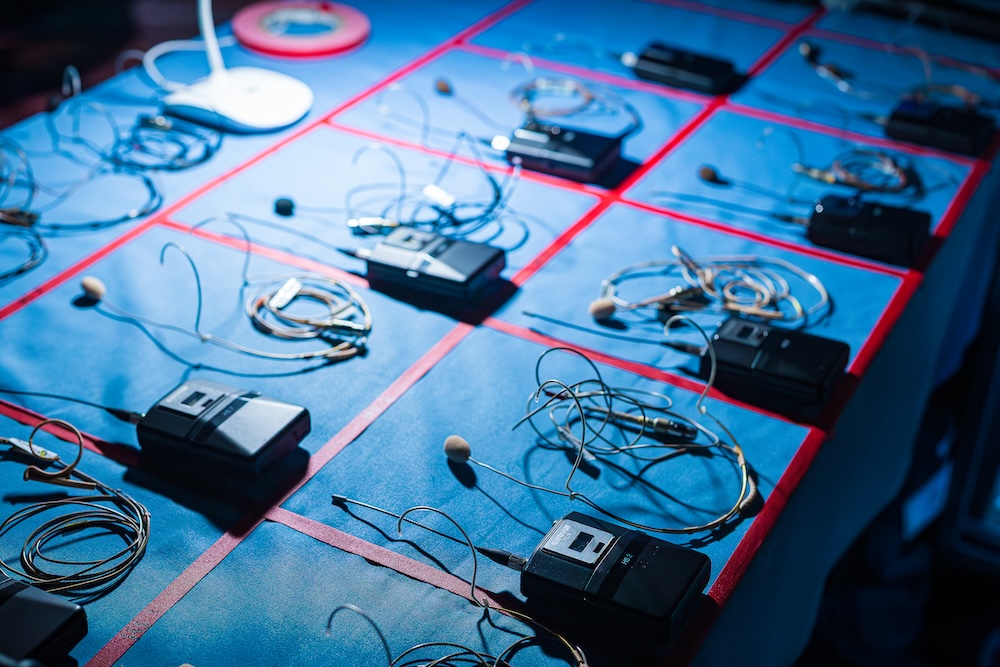
At Technical Elements, we run Shure Axient Digital, ULX-D, and QLX-D wireless systems, along with DPA lavaliers and Shure stage and broadcast mics. The reason we standardize on these platforms isn’t brand loyalty. It’s that they handle frequency coordination cleanly in dense RF environments like downtown ballrooms and arenas, where cheaper wireless falls apart.
Speakers: Match the System to the Room, Not the Headcount
Two thousand people in a long, narrow ballroom is a completely different audio problem than two thousand in a wide arena. Room shape, ceiling height, and surface materials drive the spec.
Powered speakers like the QSC K12 or JBL EON One are the right tool for breakouts, small general sessions under 200 people, receptions, and pop-up content stations. They’re fast to deploy, sound great at moderate levels, and don’t require a separate amp rack.
Line arrays are what you need the moment the room gets serious. The JBL VTX A12, A8, and A6 systems we deploy on larger general sessions throw sound evenly across long rooms without blasting the front row to keep the back row engaged. Distributed compact line arrays prevent audio “hot spots” and uneven coverage, which is what keeps speech intelligible, whether someone is in row 2 or row 42.
Subwoofers like the JBL VTX B28 add the low-end warmth that makes walk-in music, video playback, and any musical moments actually feel like an event instead of a meeting. Skip them for content-only sessions. Add them anytime energy matters.
Monitors are the speakers you don’t see, pointed at the talent. The JBL VTX M20 lets a keynote hear themselves clearly so they don’t shout or pull off-mic. If your presenter has ever sounded uneven during a recording, lack of proper monitoring is usually why.
Delay fills are the unsung hero of large rooms. For deep ballrooms or arena-style setups, additional speakers placed further back, time-aligned to the mains, keep the audio arriving in sync with what people are watching on stage. Without them, the back third of your audience hears a smeared, delayed version of the show.
The Mistakes That Quietly Wreck Events
We’ve walked into enough rooms to see the same problems repeat. Three to watch for:
- Wireless frequency conflicts.
Downtown venues, convention centers, and hotels stacked with simultaneous events create RF chaos. If your AV partner isn’t coordinating frequencies in advance, expect dropouts. This is also why renting six wireless mics from six different sources is a recipe for failure.
- Treating audio as an afterthought.
Lighting and LED walls get spec’d early. Audio gets spec’d last, often after the room and seating are locked. By then, you’re solving acoustic problems with gear instead of planning. Spec audio early.
- Skipping the sound check, or running one with the wrong people in the room.
A sound check with an empty room sounds nothing like the same room full of warm bodies absorbing sound. Build in time for a check with at least part of your event team in the seats and your actual presenters on the mics they’ll use.
Build Your Audio Plan Around Three Questions
Before you talk gear with any AV partner, get clear on three things:
- How will presenters move? Standing, pacing, panel-style, demoing? That answers your mic question.
- What’s the room actually like? Get dimensions, ceiling height, surface materials, and any obstructions. That answers your speaker question.
- What does your content sound like? Talking heads only, or music, video, and live moments? That tells you whether subs and full line arrays are required or overkill.
A good production partner should be asking you these questions before quoting. If they’re not, that’s a signal.
The Takeaway
Great event audio isn’t about owning the most expensive mics or the biggest speakers. It’s about matching the right microphones and speakers to your presenters, your room, and your content, then having a team that coordinates the details before anyone walks in. When audio works, no one notices. When it fails, no one forgets.
If you’re spec’ing audio for an upcoming corporate event and want a partner who plans before they quote, request a custom quote from Technical Elements. We’ll help you build a system that fits your room, your run-of-show, and your audience.